Showing posts with label indie. Show all posts

Monday, May 9, 2011

Editing as an Indie Writer: Twitter Requested Topic

See that picture over there? Yeah, that's me. Well, my red hair is past my shoulders and I would never be caught dead wearing a green shirt, but the implied curse words, exasperated expression, and crumbled pieces of paper? Yeah, that's TOTALLY me when I'm editing.

I put out a call on Twitter for blog topics and ME Summer (@mesummerbooks) said: How to self-edit a story so well that it's as if it has been edited by a professional.


So how do I edit as an indie author? Here's my process:

I write my novel, usually in 30 days (I like the NaNoWriMo method), and then I let it simmer for a few weeks. Then I print it out and edit by hand, with a red pen naturally. I enter all of those changes back into my document and retitle it Second Draft.

YAY! I'm done and ready to go to print!!!! Right? WRONG!

Then I send that copy out to various beta readers. As can you imagine, I have about a zillion writer friends. At this point I usually know what my novel's kryptonite is. Could be story, flow, timing, grammar, whatever. I choose beta readers specifically for their skill set. Some readers will be a beta on one book and not another. It's not because I don't like them anymore, it's simply because I know their skills and use them to my advantage.

Oubliette, for instance, just came back from four betas. You'd be surprised at the breadth of their comments. Except for a few missing words here and there, their comments were completely different! I print a fresh copy of my manuscript and I use my red ink pen to mark all of the corrections on that one copy. Then I enter all of those in my manuscript and save it as Fourth Draft.

YAY! I'm done and ready to go to print!!!! Right? WRONG!

Then I ship my book off to at least two people who proofread. I enter those mistakes into my text, read it one more time, and then it's off to print (well, after extensive formatting, but that's not relevant in this blog post).

I don't take editing lightly. In fact, editing takes far longer than the writing does. Writing takes 30 days, editing can take months. This is why Oubliette, which was originally supposed to release this month, was pushed back until the end of June. When I did my first round of edits, I slashed 10,000 words - one-fifth of my novel. Then I rewrote it. I refuse to release a product I'm not proud of. I know some readers were disappointed they had to wait an extra month to read Oubliette, but trust me, it's totally worth it.

Editing can make, or break, a novel's success. Never rush through it. Never.

Thursday, April 7, 2011

Oh, Shut Up!: Indie vs. Traditional

Anyone else getting tired of all the arguing? Am I the only one watching this and rolling my eyes?

Yes, I am indie, self-published, whatever you want to call it. (Big debate on Nathan Bransford's blog about this yesterday.)

No, I don't hate New York, agents, or traditional publishing.


Barry Eisler turned down traditional publishers to go indie! *gasp*

Amanda Hocking signed a contract with traditional publishers! *gasp*

It amazes me how much press has centered around how they are both traitors to their roots, not on the achievements and contributions both have made to the greater publishing world. Both have been asked to justify their positions. Really? Why? Let them make their business decisions without facing persecution. It isn't a big deal if they want to discuss their decisions, but they shouldn't have to defend themselves.

The readers aren't complaining and I'd say 95% of this anger stems from in-fighting.

Why can't everyone get along? Why does it have to be one or the other? Plenty of self-pubbed authors have gone on to great success in the traditional world. Others have left traditional publishing for the indie world. I want to know why writers/editors/agents/publishers can't be happy for each other.

Why? Can anyone answer me that?

Monday, April 4, 2011

Winner & What's Coming Next!!!!

There is a black hole in my brain where names are concerned, especially for important characters. I have so much trouble naming them and I'm thrilled people are willing to help me out!

Eighteen names were suggested for the prophet. If you've read Anathema, you know who he is. If you haven't, then you should go out and buy a copy. (Links to the right.) He plays a more prominent role in Oubliette and I couldn't get away anymore without a name.

I had a hard time choosing and I narrowed it down to seven favorites. Then my eight-year-old and I had a powwow. We discussed the merits of each name and quickly narrowed it down to two names. Then she told me it was too hard and I had to choose. So I went with my gut an chose:

ZELOR

I love Zelor. Just like my character it's creepy, old-fashioned, and a little insane.

A big congrats to LunaMoth, reader and book blogger with the most gorgeous website! Definitely check it out.

So what's coming up on the blog? On Tuesdays I'm starting a new feature called Trailer Tuesday. I happen to adore book trailers and I want to share some with my readers. It won't be only indies, I'll definitely feature some traditionally published books too.

On Thursdays I'm going to make an honest attempt to blog....about something....hopefully something interesting. I'm also open to suggestions if there's anything anyone wants to hear about self-publishing, or writing, or bats (which I know a lot about too).

Wednesday, March 23, 2011

Q & A with Andrea Brown Agent Mary Kole: Indies & Agents Can Co-Exist

It seems to me that a lot of trad & indie authors have drawn a line in the sand. Them on one side, us on the other. I think there's room for all of us in this big world of publishing, but I know a lot of people don't feel that way.

Last year, Mary Kole, an agent with Andrea Brown Literary Agency thought self-publishing was a bad idea. At the time, I agreed with much of what she said. Since then I've changed my mind and when I read Mary's recent post Self-Publishing in Digital Times, where she admitted she might have been wrong, my jaw dropped.

The publishing world is evolving. Indie princess Amanda Hocking is close to a traditional deal while bestseller Barry Eisler turned down a $500,000 traditional deal to self-publish. While everyone has an opinion on where the industry will land, no one really knows. I think we're all full of questions and Mary was gracious enough to take some time out of her busy schedule to answer some for me. I wanted to know how agents and indies can work together. Just because I chose not to pursue representation for the moment, doesn't mean I've ruled it out forever.


I hope you'll take a few minutes to read Mary's thoughtful answers.

Q. I read your post in 2010 concerning self-publishing, and at the time I agreed with most of what you said. However, my mind was changed in December while reading about L.J. Sellers and her decision to pull her work from her publisher in favor of going indie. What, or who, caused a shift in your thoughts about self-publishing?

A: The advent and popularity of ereaders and digital books really changed my mind. The problem with print self-publishing is distribution. I would see a lot of writers hoofing around with their printed books or spreading their POD links all over the place but, for the most part, failing to get distribution in brick and mortar stores or attention among e-tailers. With ebooks so readily available and so easy to make and upload, and with new lists and stores popping up to increase a writer's chance of discoverability in the marketplace, it's now possible to forget about distribution woes and get attention for your independently published book. Lists and other curator resources, like reviewers, also work toward spotlighting truly worthy independently published projects. There will still be self-published books of poor or amateurish quality, but that cliche of disgruntled writers self-publishing just because the gatekeepers have all rejected them is now fading. Now people are self-publishing with new tools and, in some cases, to take complete control of the process (and potential profits).

Q. It’s my firm belief that indies and agents can co-exist, and even enhance each others careers. How do you see the agent’s role evolving in regards to indies?

A: ABLA is now developing a digital business model where we're going to address just that. The truth is, a writer can now publish independently without an agent or traditional publisher. It's dishonest to lie and say that agents are necessary if you want to go the digital route. So how do we justify our existence and commission? What's the value we add? I'll be able to articulate that much more precisely once we can finally announce our digital strategy, but I'm afraid I don't want to go there prematurely. Suffice to say, it's what we all need to be thinking about if we want to stay in and on top of the game. I'm really not trying to evade the question...I just am not ready to give you the really solid answer that this question deserves.

Q: I think your last answer is more than fair. Do you think agents will become more open to handling subsidiary rights (audio, foreign language, film/TV) for indie authors, while letting them maintain their print and ebook rights?

A: Yes. That's how Amanda Hocking got her agent in the first place. I feel like this is one thing that agents can do really well in a more indie-friendly publishing culture, which seems like it will be upon us by this time next year. It's interesting to note, though, that as the news broke that bestselling traditionally published author Barry Eisler turned down a $500,000 print deal from St. Martin's, Amanda Hocking was generating a seven figure auction for print books! There's obviously flexibility in going from print to indie and vice versa. But so far, it's also good to note that only big name authors, whether they got their big name from print or indie, are generating the kinds of advances and royalties that are making headlines. It's a very different picture for the average author, whether traditionally or independently published.

Q: Are you concerned the larger publishing companies will shun agents who have clients uninterested in selling U.S. print and ebook rights?

A: I think it would be problematic with US publishers, but not necessarily foreign publishers. A publisher wants your print rights. More and more, they want your digital rights, too. But some publishers work with (again, established, in most cases) authors who have strong digital plans. For example, I believe Cory Doctorow kept his own digital rights and also copyrights under a Creative Commons license so that his fans can remix and interpret his text. So his print publisher, Tor, was cool with that but...again...he's well-known and has the leverage to negotiate that. This type of arrangement may become more common in the near future.

Q: You mentioned in your recent blog post that marketing is tricky for indies. How is their marketing different from a mid-list traditionally published author who isn’t receiving publicity support from their publisher?

A: One thing that publishers do really well is they sell into bookstores and schools/libraries on your behalf. Their sales people connect with buyers for these businesses and institutions so while a midlist author (who usually doesn't get a big publicity push from their publisher) is online and trying to market themselves, the publisher is working behind the scenes to sell them through to retailers. An indie author will have to connect and network not only with readers but also with people who will give them opportunities to sell books, do appearances, visit schools (for children's books). It's an additional layer and audience that will need its own marketing message from indie authors.

Thank you so much, Mary, for stopping by and answering these questions. I think blog posts like this will become more and more common in the next year or two as everyone considers their place in modern publishing.

I know my friends and I at DarkSide Publishing will continue to strive to release quality ebooks for readers. Will we all remain there forever? Will any of us get agents? What paths will we follow? No one knows, but I think in a publishing world where indies, agents, and publishers work together we can't go wrong.


Monday, March 14, 2011

Contest Winner & My Sales - You Might Be Surprised....

First, I want to thank everyone who entered the contest, everyone who helped spread the word about Anathema, and everyone who purchased a copy. You've all helped in making my dreams come true.

Now let's choose our winner! Two of my entrants tied for the closest guess to the number of books I sold from February 10th through March 11th. To keep things fair, my spastic miniature schnauzer, Ace, will choose the winner!


CONGRATS ERIN, our Grand Prize Winner - Kindle or Nook or $150 gift card & a free copy of Anathema!

1st Runner-Up, Terah wins $25 gift card and a free copy of Anathema

2nd Runner-Up, Tony wins a DarkSide prize pack!


Wait! I announced the winners - but NOT the winning number. Yeah, this is where things get interesting.

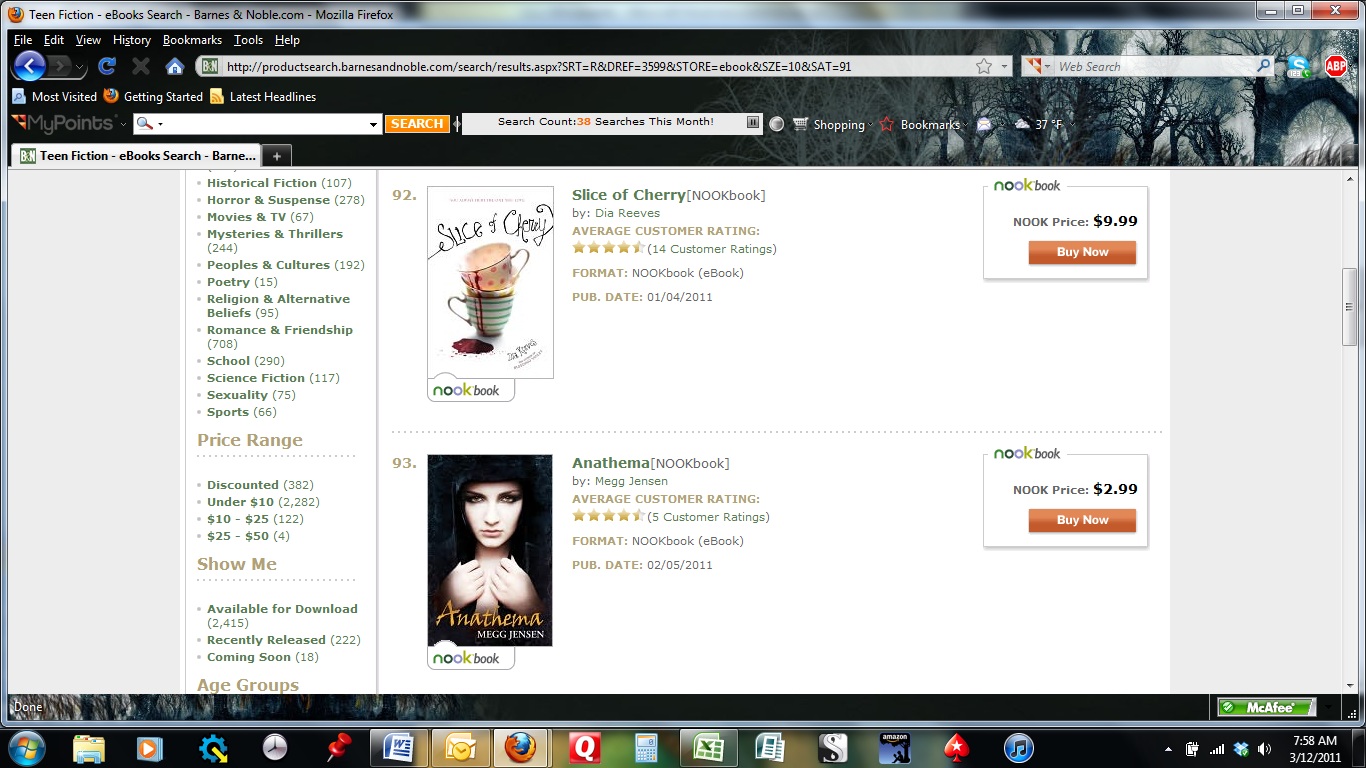
If you've been following me on Facebook, you know I made the Barnes & Noble Teen ebook bestseller list. I cracked the top 100:

See my book at #98, just above Maggie Stiefvater's Shiver at #99? This was March 8th.
And here I am at #96, just above Lauren Kate's Fallen on March 11th
March 12th, #93.


You must be thinking ... OMG, Megg has sold hundreds, even thousands of books in her first month to hit that list!

You're wrong. Here are my totals:

February 10th - 28th: 62 ebooks; 20 paperbacks
March 1st - 11th: 55 ebooks; 15 paperbacks
Grand total: 152

90 of those ebooks were sold through Barnes& Noble. 90. I sold 90 and hit the bestseller list.

I have no idea how they calculate placement on the list. My colleague at DarkSide Publishing, Karly Kirkpatrick, has sold hundreds more than me since she debuted in November. She's on the list, for sure, but she hasn't cracked the top 100. So why have I?

The consensus is that it has something to do with how quickly my books sold and that I had a few days with pretty high numbers of sales.

This also tells me the teen ebook market is WIDE OPEN. If I can achieve this on my first book in a month, imagine what you can do!

Am I disappointed with my sales? Hell NO! I'm thrilled someone other than my mom bought my book. I'm thrilled people are enjoying Anathema. I'm thrilled strangers have found it and embraced it. Isn't that what every writer wants? And let's remember, this is only the beginning. I have the two other books in my Cloud Prophet trilogy dropping this year. In addition to that I have multiple completed novels begging me for final edits so they too can see the light of day. People who've read my upcoming books have remarked that my writing is better, the plots are tighter, and the issues I deal with go much deeper. And then there's my contemporary YA novel about a ninja-fighting teenage girl. But that's a story for another post....

Now, do me a HUGE favor and head over to G.P. Ching's blog to read the first chapter of her novel The Soulkeepers. I promise, you'll be begging for more!!!

Wednesday, January 26, 2011

When Dreams Change

I'm a traditional girl in many ways. For years I dreamed of walking into a bookstore or a library and seeing a hardcover with my name on the front. As someone who loved to write since early childhood, I believed that to be the pinnacle of success for a writer. My name - in print - for all to see.

I'm 35 now and the world has changed. I don't browse library shelves; I load up their website, place a hold on a book that they may or may not carry (because they'll just borrow it from another library for me), and get an email telling me it's in. Then I pop into the library for five minutes, at the most, to pick up the book I put on hold. I don't spend time combing through the shelves. Why? There's simply too much to browse through. Fiction is shelved alphabetically, not by genre. I wish fiction was more like the Dewey Decimal System, where all nonfiction is shelved by topic.

I get my book recommendations from friends and family, colleagues and blogs, or by basic word-of-mouth. It's rare for me to be left wondering what to read next because I maintain a list a mile long. I will never, ever run out of books to read - which is a wonderful thing.

But as the "great" rejections from agents piled up, I began to get a little sad. What was I doing, spending two years writing when I was never going to make it? They kept telling me my writing was great, but that the market was too narrow for my work. Narrow? How can a world as wide-open as books ever be too narrow?

The more I thought it about it, the more I realized I simply want people to read my books. I don't have to be on a shelf in a bookstore for that to happen anymore. I don't have to be a New York Times bestseller. What I want is to put a smile on someone's face or make a heart pound just little faster.

I've been published regularly for years as a under my secret journalist identity. I've seen my name in print more often than I can count. You know what? It gets old. It does and I'm sorry if that upsets anyone, but the thrill of seeing my name in a magazine wore off within a year or so. If my biggest goal in traditional publication was to see my name on a hardcover book, I bet eventually that thrill would wear off too.

It's not about seeing my name in print anymore - it's all about sharing the stories I have. My goal is to entertain you, not to feed my own ego.

Peace,
Megg

Tuesday, January 18, 2011

Release Date Pending....

Everyone keeps asking me when my book will be out ... and I wish I had an answer. Soon is about the best I can do.

Since I'm new to the whole epub thing, I don't have a good gauge for how long everything will take. I'm currently in the midst of revisions and I hope to have those done within the next two weeks. Then there's formatting and other things that need to be done before I can release the book.

Some of you are really excited to read it - which makes me really excited too!!!! And maybe a little scared....

I'm going to keep you updated on everything I'm doing. But, for now, I'm mired in revisions.

Thanks for hanging out with me for a few minutes!

Megg

Wednesday, January 5, 2011

Creating a Cover

One of my favorite aspects of going indie has been the control factor. Everyone who knows me will tell you what a control freak I am. When I was pursuing traditional (trad) publishing, I knew that I'd have little to no input on my cover.

What a bummer, right?

Don't you hate it when a cover totally misrepresents a book? The hair color is wrong, the clothes aren't even close and there have even been some books where the SKIN COLOR is wrong, like African-American main characters portrayed as Caucasians on the cover. That is so, so wrong.

I have a basic concept of where my cover is going and unless they're lying to me, my indie buddies agree with me - my cover is absolutely amazing. It's a black background (my favorite color, natch) and depicts a scene from my novel. It's fantastic and I can't wait until it's done so I can share it with you. It will be an amazing reveal (crap....sounding like reality shows again...)!

I've spent more time staring at the artwork than I should, really. I have to get back to revisions. None of this is worth it unless I have a book to share with you, right?